Available from:
PRO-ED, Inc.
8700 Shoal Creek Blvd.
Austin, TX 78757
www.proedinc.com |
Word Finding Intervention Materials
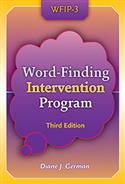
Word Finding Intervention Program-Third Edition (WFIP-3)
The third edition of the Word Finding Intervention Program (WFIP-3) provides professionals with theoretically linked and research-based interventions to address learners' Word Finding Skills. The WFIP-3 uses a three-pronged approach to Word Finding intervention: Retrieval Strategy Instruction, Self-advocacy Instruction, and Differentiated Assessment and Instruction in the classroom.
WFIP-3 highlights include:
- Retrieval strategies matched to learners' Word Finding error patterns;
- Lessons provided to teach Metalinguistic Retrieval Strategies for multisyllabic words;
- Lessons provided to teach phonologically based Mnemonic Retrieval Strategies to anchor evasive target words and syllables;
- Lessons provded to teach Metacognitive Elaborative Rehearsal;
- Lessons provided for teaching Self Monitoring and Self Correction of fast inaccurate retrieval errors;
- Lessons for teaching Word Finding Self Advocacy Skills;
- Lessons for implementing Differentiated Assessment and Instruction in the classroom in areas of oral classroom discourse, oral reading, and written language;
- Word Finding accommodations for modifying clients' language environment to facilitate their retrieval at home, in the classroomk, and at work;
- Technology Resources for Retrieval Strategy Instruction;
- Annual Goals and Instructional Benchmarks for all lessons;
- Progress Monitoring in Word Finding;
- Thematic vocabulary lists already matched to Retrieval Strategies for immediate use with school age students; and
- Revised Word Finding Referral Checklist (WFRC-2).
Target Users: Speech and Language Pathologists and Special Education Teachers
Target Learners: Preschool (4 yrs) and School-age clients and adults with Word Finding difficulties.
|
A Comprehensive Intervention Program
Programming in Word Finding needs to be comprehensive with respect to its focus and its application. Effectiveness is dependent on teaching and learning of retrieval strategies, linguistic based accommodations of both school and home communication environments, and an understanding and self application of these strategies and accommodations by the learner. Therefore, a comprehension intervention program in child Word Finding would focus on three areas (German, 1993, 2005):
- Retrieval Strategy Instruction
- Self Advocacy Instruction
- Word Finding Accommodation
Retrieval Strategy Instruction
Retrieval Strategy Instruction is directed towards improving students' retrieval of words that they know and have used before. Strategies are applied to new vocabulary after students have indicated that they recognize and know meanings of these words. Retrieval Strategy Instruction focuses on providing students with mnemonic retrieval strategies and metalinguistic reinforcement to aid Word Finding in single word and discourse contexts.
Steps include:
- Select appropriate retrieval strategies and teach using relevant
thematic material.
- Apply strategies to aid retrieval of known words in sentences and
in discourse contexts.
- Rehearse target words in meaningful discourse contexts, focusing
on self application of strategies.
- Generalize Retrieval Strategy Instruction to recreation
and academic activities.
Back to top
Self Advocacy Instruction
Self Advocacy Instruction helps learners develop their "executive system" around
their Word Finding abilities. Learners are taught to advocate for
themselves with regard to their retrieval skills. Specific objectives
include:
- Helping learners become aware of their strengths and weakness
in oral retrieval through self-monitoring;
- Taking responsibility for improving their retrieval skills
through self-instruction;
- Becoming aware of the Word Finding accommodations that they need.
Word Finding Accommodations
Word Finding Intervention also considers accommodations of oral and written language demands in the learner's academic work. Learners with Word Finding difficulties are often better able to express their understanding of studied material when they do not have to use their oral or written language to show their knowledge. Therefore, accommodations that reduce retrieval demands inherent in learners' academic and recreational environment are recommended. The objective is to remove barriers to learning brought about by tasks that focus on the student's ability to orally retrieve or write information. Recommended Word Finding Accommodations include:
- resource notebooks or cue cards to be used during exams
- open book or take home exams
- multiple choice and true-false frames in exams
- software applications
- discourse menus
- volunteer participation in oral classroom work
- teacher use of multiple choice during oral questioning in the classroom
Click here for a complete list of references.
Back to top
|

